
When NVIDIA Comes Back
The World’s Most Powerful AI Company Keeps Returning to Babcock.

The first time means curiosity. The second time means something else entirely.
NVIDIA — the company whose GPU chips power everything from ChatGPT to cancer diagnostics, whose infrastructure underpins the global AI revolution, and whose CEO Jensen Huang has become one of the most consequential figures in the history of computing, has now made Babcock University a recurring destination. That is not a small detail. That is a statement worth understanding.
BUCC is the leading tech community at Babcock University, with over 4,000 students shaping the campus tech ecosystem through code, community, and innovation. But building a community is different from attracting global industry. The former takes passion. The latter takes credibility — and credibility is earned, not announced.
A Relationship Built on Proof
The foundation of the NVIDIA–BUCC relationship was laid through the NVIDIA Deep Learning Institute (DLI) — NVIDIA’s flagship technical education program. The DLI offers hands-on experience with the most widely used, industry-standard software, tools, and frameworks in AI, data science, and accelerated computing, with participants earning NVIDIA certificates of competency upon completion.
What distinguished BUCC’s engagement with the DLI is not just that it happened — it is that it happened here, on a campus in Ilishan-Remo, Ogun State, and that students showed up. In numbers. Across multiple sessions.
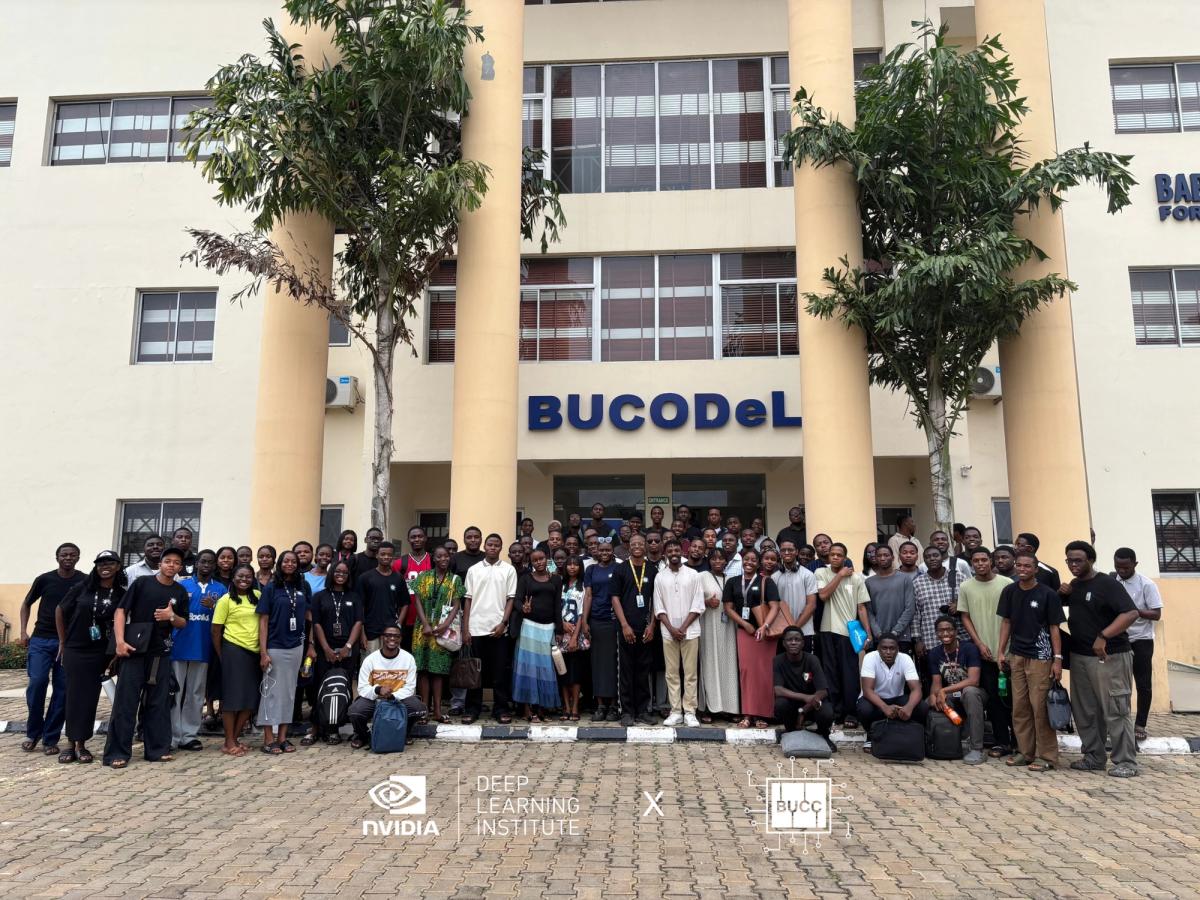
By the third session of the NVIDIA DLI Workshop at Babcock, over 100 students had earned their certificates — a figure that tells its own story. Those were not passive attendees. Those were students who sat through technically demanding content, completed assessments, and walked away with industry-recognized credentials in deep learning. The message BUCC sent to NVIDIA with that turnout was simple: our students are serious. NVIDIA listened.
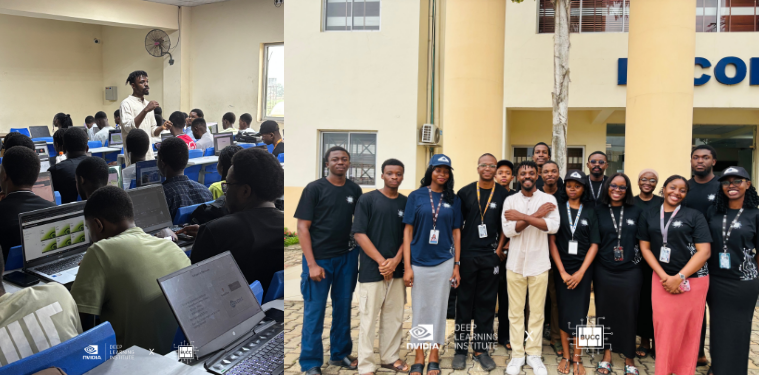
The Return: RAG, NIMs, and the Frontier of AI
The most recent chapter of that relationship arrived in the form of a seminar on Retrieval-Augmented Generation (RAG) — a technique that sits at the current frontier of applied AI development. The session, co-organized by BUCC, explored how modern AI systems can move beyond the limitations of what a model was trained on, using vector databases and semantic search to retrieve accurate, real-time information at the moment of query. In practical terms: instead of building AI that hallucinates confidently, developers can build AI that actually knows things accurately.
NVIDIA’s own infrastructure stack was central to the discussion: NIMs (NVIDIA Inference Microservices), TensorRT-LLM for optimized model serving, and the Triton Inference Server — tools that are not academic abstractions, but live production infrastructure used by companies building at scale. The technical depth of the session matched the ambition. Attendees were walked through the mechanics of embeddings — how language gets converted into mathematical representations that machines can reason with, and the specialized vector databases that make real-time semantic search possible.
That is the level of content that landed in a student room at Babcock University.
What a Return Visit Actually Means
It is worth stepping back to appreciate what this means in context. The NVIDIA DLI University Ambassador Program exists to enrich university curriculum with hands-on workshops in cutting-edge technologies. Universities earn that access through demonstrated capacity. They earn repeat visits by proving that the first visit mattered. Babcock has now done both.
Babcock University is home to over 13,000 students across six faculties. Among those students is a generation of builders who have spent the last few years watching the AI revolution happen on a screen — and are now, through initiatives like these, being handed the tools to participate in it directly. The question of whether African students can compete at the frontier of technology is one that gets asked often, usually by people who have not been paying attention to what is quietly happening in rooms like the ones BUCC has been filling.
The answer, it turns out, is being demonstrated, not argued.
NVIDIA does not return to places where the work is not being done. The fact that they keep coming back to Babcock is not courtesy. It is recognition.
Have a tip or a response to this story? Reach us at editor@babcocktorch.com